Journal article
Features of the planning and design of a restaurant establishment based on Slow Food principles
N. I. Hirenko · D. P. Kramarenko · K. B. Nechepurenko · N. O. Bykadorova · A. O. Yesipov
 Publication · 10 pages
Publication
Open file ↗
Page 1 · text
Theory and practice of design. Issue. 2 (40). 2026
ISSN 2415-8151 (Print), 2786-8664 (Online)
[42]
Hirenko N., Kramarenko D., Nechepurenko K., Bykadorova N., Yesipov A. (2026). Features of the planning and design
of a restaurant establishment based on Slow Food principles. Theory and practice of design.
Аrchitecture and construction. 2 (40). P. 42–51.
doi: https://doi.org/10.32782/2415-8151.2026.40.5
UDC 640.43:72.036(477.54)
DOI https://doi.org/10.32782/2415-8151.2026.40.5
FEATURES OF THE PLANNING AND DESIGN
OF A RESTAURANT ESTABLISHMENT BASED
ON SLOW FOOD PRINCIPLES
Hirenko Nataliia Ihorivna1, Kramarenko Dmytro Pavlovych2,
Nechepurenko Krystyna Borysivna3, Bykadorova Nataliia Oleksiivna4,
Yesipov Andrii Olehovych5
1 Candidate of Technical Sciences, Associate Professor,
Associate Professor at the Department of Professional Education,
Restaurant and Tourism Business,
Luhansk Taras Shevchenko National University, Lubny, Ukraine,
e-mail: n.i.hirenko@gmail.com, orcid: 0000-0001-6854-8257
2 Candidate of Technical Sciences, Associate Professor,
Associate Professor at the Department of Hospitality and Catering Business
and Craft Technologies,
Simon Kuznets Kharkiv National University of Economics, Kharkiv, Ukraine,
e-mail: kramarenkodp@gmail.com, orcid: 0000-0003-1353-686X
3 Candidate of Technical Sciences,
Associate Professor at the Department of Hospitality and Catering Business
and Craft Technologies,
Simon Kuznets Kharkiv National University of Economics, Kharkiv, Ukraine,
e-mail: krystyna.nechepurenko@hneu.net, orcid: 0000-0002-1815-2542
4 Senior Lecturer at the Department of Professional Education,
Restaurant and Tourism Business,
Luhansk Taras Shevchenko National University, Lubny, Ukraine,
e-mail: itottstar@gmail.com, orcid: 0000-0002-7561-1792
5 Senior Lecturer at the Department of Architecture,
Kharkiv State Academy of Design and Arts, Kharkiv, Ukraine,
e-mail: esipov1995@gmail.com, orcid: 0000-0001-8657-0714
Abstract. The purpose of the article is to provide a comprehensive analysis of
the theoretical and methodological foundations and practical aspects of the design
and development of a restaurant business establishment operating in accordance
with the principles of the Slow Food concept, as well as to consider the specific
conditions for the implementation of such an object in Kharkiv under martial law and
the prospects for post-war recovery.
Methodology. The study used a set of general scientific and special
methods: analysis and synthesis – to systematise the regulatory framework and
scientific publications; comparative analysis to compare approaches to the design
of the Sustainable Food Facility in international and domestic practice; systematic
approach to consider design issues in the interconnection of architectural, functional,
technological and safety aspects; generalisation to formulate conclusions and practical
recommendations.
Results. The philosophical and conceptual foundations of the Slow Food
movement and their projection onto the architectural paradigm of Slow Architecture
have been determined. The global trends in the development of the Slow Food concept,
including the principles of sustainable development, digitalisation and gastronomic
Page 2 · text
ISSN 2415-8151 (Print), 2786-8664 (Online)
Теорія та практика дизайну. Вип. 2 (40). 2026
[43]
Гіренко Н. І., Крамаренко Д. П., Нечепуренко К. Б., Бикадорова Н. О., Єсіпов А. О. Особливості
проєктування та дизайну закладу ресторанного господарства з впровадженням принципів Slow Food.
Теорія та практика дизайну. Архітектура та будівництво. К.: КАІ, 2026. Вип. 2 (40). C. 42–51.
doi: https://doi.org/10.32782/2415-8151.2026.40.5
tourism, are systematised. The specifics of the restaurant industry in Ukraine in the
context of a full-scale war are considered. The concept of the Slow Food concept
is formulated. The features of interior design are analysed, taking into account the
security situation, as well as the requirements of DBN B.2.2-5:2023 for the design of
dual-purpose protective structures.
Scientific novelty. A conceptual model for the design of Slow Food-format
RSFs in the context of armed conflict is proposed, combining the principles of Slow
Architecture, wartime security imperatives, and the regional cultural identity of the
Kharkiv region. For the first time, the approaches to the design of dual-purpose
shelters in the Slow Food concept are systematised.
Practical relevance. The results of the study can be used by design
organisations, restaurant business investors, and local governments in the
development of concepts and projects for TACs in Ukrainian cities located near the
combat zone. The proposed solutions for dual-purpose spaces allow optimising capital
expenditures and increasing the investment attractiveness of the establishment.
Keywords: Slow Food, restaurant establishment, Slow Architecture, design,
interior design, sustainable development, wabi sabi, protective structures, DBN
B.2.2-5:2023, Kharkiv, martial law, gastronomic tourism, local products, open
kitchen, security solutions.
INTRODUCTION
The modern hospitality and restaurant in-
dustry is in a state of deep structural and value
transformation, which is caused by a complex
of global and local factors. The era of mass con-
sumption, characterised by the dominance of
transnational fast food chains, is gradually giving
way to conscious models of gastronomic behav-
iour. A fundamental alternative to the stand-
ardised approach to food is the concept of Slow
Food, which emerged in Italy in 1986 under the
leadership of Carlo Petrini as a socio-cultural re-
sponse to the expansion of globalisation and the
loss of local culinary identity [20]. Originating
as a protest movement against the opening of
a fast food restaurant in the historic centre of
Rome, Slow Food quickly evolved into a large-
scale international organisation whose activi-
ties today cover not only gastronomy, but also
ecology, sustainable development policy, pro-
duction ethics and the architectural environ-
ment [20].
The topic of designing Slow Food concepts
is especially relevant in the context of modern
Ukraine, where the full-scale military invasion
of 2022–2025 has radically changed approaches
to the restaurant business, increasing the need
to shorten supply chains and ensure the safety
of visitors [8]. The city of Kharkiv, as a front-
line metropolis that demonstrates incredible re-
silience and actively shapes post-war develop-
ment strategies, is a representative platform for
exploring the possibilities of designing a new
generation of RSGs [9]. The connection with the
scientific and practical tasks of reconstruction
and new construction of HoReCa facilities under
martial law determines the relevance and feasi-
bility of this study.
ANALYSIS OF RECENT RESEARCH
The issue of designing restaurant facilities
with regard to the concepts of sustainable de-
velopment is being actively studied by scientists
in various aspects. The Slow Food movement of-
fers the Ukrainian restaurant industry a holistic
and promising development model that com-
bines economic success with social and envi-
ronmental responsibility [17]. The issue of mar-
keting justification for the implementation of the
Slow Food concept in the restaurant business is
covered in the works of domestic and foreign
researchers. Of particular interest is the study
by Obolentseva and other authors, which anal-
yses the essence, role and significance of the
Slow Food concept in the system of sustainable
development [24]. The conceptual foundations
of the architectural dimension of the Slow Food
movement – the Slow Architecture paradigm –
are systematically considered in works that ex-
plore the relationship between gastronomic and
spatial practices. In particular, the study on the
search for a model of «slow architecture» from
Slow Food to Citta Slow [21] is important.
Global trends in the restaurant business
towards sustainable development are analysed
in detail in the study of design strategies for cu-
linary heritage restaurants in terms of cultural
sustainability [1]. The issue of gastronomic
tourism and its connection with the Slow Food
concept is considered in a comprehensive re-
view of global trends in 2010–2025 [26]. The
influence of social media and digital marketing
Page 3 · text
Theory and practice of design. Issue. 2 (40). 2026
ISSN 2415-8151 (Print), 2786-8664 (Online)
[44]
on the promotion of Slow Food restaurants is
studied in the study of TripAdvisor use in res-
taurants of the corresponding format [25]. The
issue of restaurant interior design as a factor of
visitor satisfaction is revealed in the research of
the Rochester Institute of Technology [11].
The specifics of the restaurant business in
the context of the armed conflict and the pros-
pects for the recovery of the hospitality market
in Ukraine have been explored in a number of
publications. The issues of Kharkiv’s reconstruc-
tion and the development of new approaches to
urban planning are considered in UNECE analyt-
ical materials [10]. Despite the wide coverage of
certain aspects, there is a lack of comprehensive
research that integrates the architectural design
of the Slow Food concept with wartime security
requirements and the specifics of the Kharkiv
context. This article is dedicated to solving this
problem.
PURPOSE
The purpose of the article is to conduct
a comprehensive study of the theoretical and
methodological foundations and practical as-
pects of the design and construction of a res-
taurant establishment operating in accordance
with the principles of the Slow Food concept, as
well as to consider the possibilities and features
of implementing such a project in Kharkiv under
martial law.
THE RESULTS OF THE RESEARCH AND
THEIR DISCUSSION
The philosophical basis of the Slow Food
concept is based on three fundamental prin-
ciples that determine the vector of develop-
ment for both agricultural producers and res-
taurant businesses: «Good, Clean, Fair» [20].
The «Good» principle declares the need to re-
turn to natural flavours that are not distorted
by chemical enhancers, which are widely used
in the fast food industry to mask the low quality
of raw materials [24]. In addition, this principle
requires the cultivation of gastronomic pleasure,
slowing down the process of food consumption
and creating a culture of communication at the
table that promotes psycho-emotional well-
being [22].
The Clean principle reflects the environ-
mental dimension of the philosophy. In the
context of the restaurant business, this prin-
ciple requires the establishment to minimise its
carbon footprint by switching to environmen-
tally friendly raw materials, optimising the re-
cycling of organic waste and refusing to use sin-
gle-use plastic packaging [22]. The Fair principle
forms the ethical and socio-economic basis of
the movement. The formation of «short supply
chains» (farm-to-table) allows eliminating nu-
merous intermediaries, so that the farmer re-
ceives a fair reward for his work, and the con-
sumer receives a fresh product at an adequate
price [22]. The integrated implementation of
these three principles in the design and opera-
tion of a restaurant creates a sustainable busi-
ness model that can generate not only economic
but also significant socio-cultural capital [4].
An analysis of the global hospitality
market shows that the Slow Food concept has
long gone beyond a niche trend, becoming a
driver of transformation for the entire HoReCa
segment. Today’s consumers, especially mil-
lennials and Gen Z, demonstrate a high level
of environmental and social awareness, which
directly affects their choice of food outlets [1].
Global crises, such as the COVID-19 pandemic
and unprecedented climate change, have only
accelerated the transition to conscious con-
sumption [13].
An important aspect of the global devel-
opment of Slow Food is the use of digital tech-
nologies to promote traditional gastronomy.
Studies show that reviews on platforms such as
TripAdvisor have a critical impact on the deci-
sion-making process when it comes to visiting
restaurants, with customers paying the most at-
tention to the quality of service, location, au-
thenticity and physical structure of the estab-
lishment [25].
The introduction of the Slow Food con-
cept in the Ukrainian restaurant business has
its own unique specifics, which are determined
by the country’s rich agricultural tradition and
the extreme conditions of the economy during
a full-scale war [24]. The full-scale military ag-
gression has radically changed the socio-eco-
nomic landscape of Ukraine, hitting the hospi-
tality industry [7]. Studies show that in the first
months of the war, almost 46.8% of businesses
stopped their operations, and among those that
continued to operate, restaurants and cafes ac-
counted for only about 6% [3]. Businesses have
faced unprecedented challenges: disruption of
supply chains, shortages of raw materials, mas-
sive outflow of skilled workers, and constant
physical threats from rocket attacks [7].
However, it is in these crisis conditions
that the Slow Food concept has demonstrated
its adaptability and economic feasibility as an
anti-crisis tool [4]. The strategy of short supply
chains, which is the core of the Slow Food philos-
ophy, allowed many establishments to survive:
local farmers were able to adapt to logistical
constraints more quickly and provide restau-
rants with the necessary raw materials. This has
Hirenko N., Kramarenko D., Nechepurenko K., Bykadorova N., Yesipov A. (2026). Features of the planning and design
of a restaurant establishment based on Slow Food principles. Theory and practice of design.
Аrchitecture and construction. 2 (40). P. 42–51.
doi: https://doi.org/10.32782/2415-8151.2026.40.5
Page 4 · text
ISSN 2415-8151 (Print), 2786-8664 (Online)
Теорія та практика дизайну. Вип. 2 (40). 2026
[45]
led to a unique synergy – the restaurant busi-
ness has begun to actively support domestic
craft production, cheese factories, local wineries
and farms [22].
In the face of constant stress and psycho-
logical strain associated with martial law, res-
taurants have transformed their social role [3].
They have become centres of social cohesion,
volunteer hubs and spaces for psychological
relief. The concept of Slow Food, with its em-
phasis on sharing a leisurely meal in a relaxed
atmosphere, is a perfect fit for this new so-
cial need [24]. At the same time, the industry
is facing new challenges: the need for autono-
mous power supply, water reserves and physical
safety of guests and staff through the construc-
tion of reliable shelters [3].
The design concept of the restaurant is
based on the Slow Food philosophy and the idea
of an organic connection with the natural en-
vironment and gastronomic traditions of the
Kharkiv region. The general idea is to create an
authentic space at that harmoniously combines a
modern level of comfort with respect for the en-
vironment and local culinary heritage, creating
a unique gastronomic experience for guests.
The location of the restaurant in Kharkiv in the
format of an autonomous one-storey building al-
lows us to implement a unique conceptual iden-
tity and establish partnerships with regional ag-
ricultural producers.
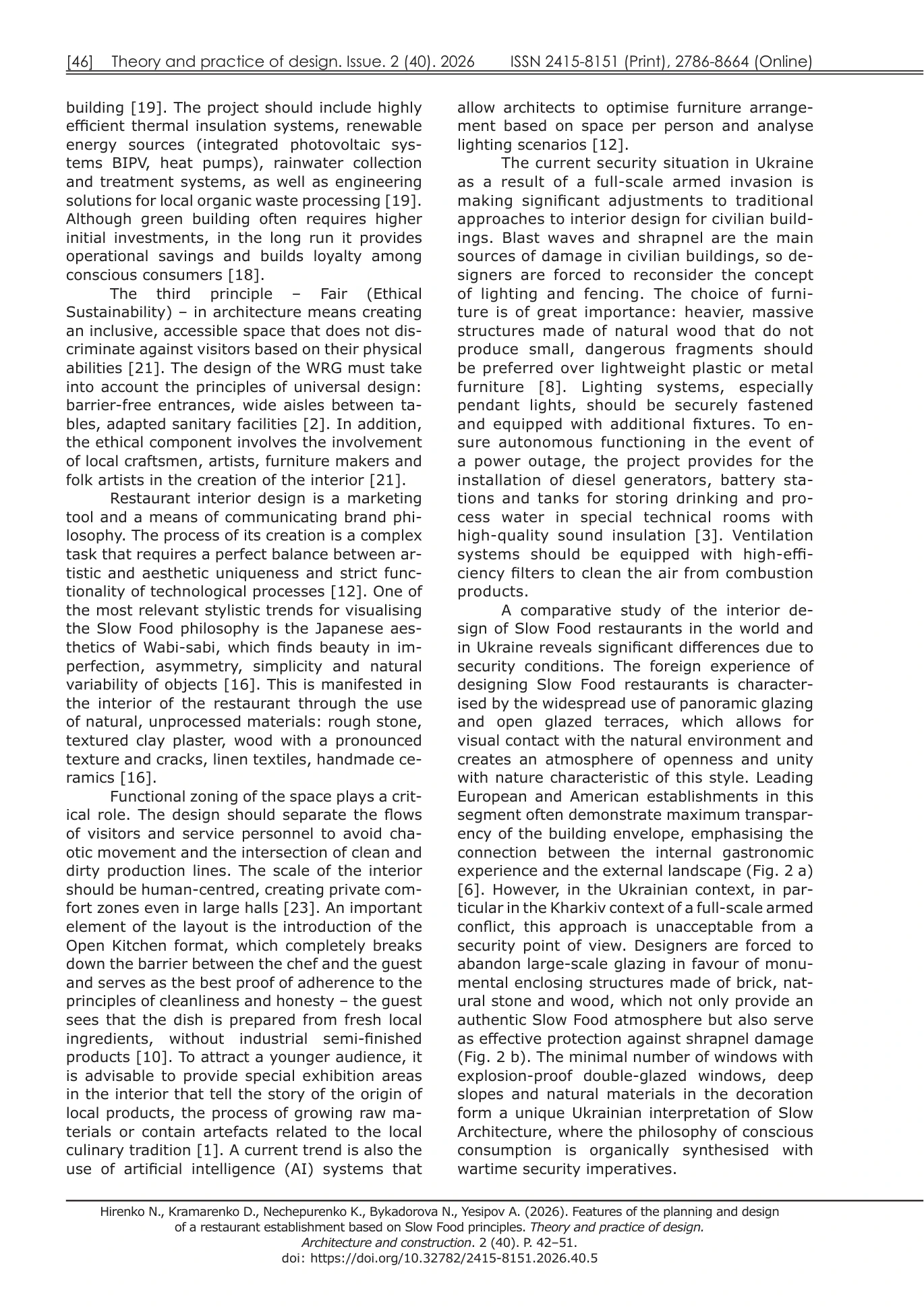
The unique selling proposition of the res-
taurant is structured around four key values that
form the competitive advantage of the estab-
lishment and differentiate it in the restaurant
market (Fig. 1).
The Slow Food philosophy cannot be fully
realised in an inappropriate spatial environment.
The integration of the ideas of conscious con-
sumption into the material world has led to the
formation of the architectural paradigm of Slow
Architecture [21]. This trend emerged in the late
1980s in parallel with the Slow Food and Citta
Slow movements as a reaction to standardisa-
tion, globalisation and the accelerated pace of
life. Slow Architecture offers a radically different
way – putting people, their sensory experience
and harmonious interaction with the environ-
ment at the centre of design [21].
The first principle – Good (Quality and
Sensuality) – implies the rejection of purely
visual dominance. The architectural space should
be perceived in a multisensory way: through the
feeling of the texture of materials (roughness of
stone, warmth of natural wood, softness of tex-
tiles), through acoustic comfort (minimisation
of reverberation, use of sound-absorbing mate-
rials) and through visual stimuli [21].
The second principle, Clean, requires the
architect to minimise the destructive impact on
the ecosystem at all stages: from the extrac-
tion of building materials to the disposal of the

Fig. 1. The concept of a Slow Food restaurant (the authors’ own development)
Гіренко Н. І., Крамаренко Д. П., Нечепуренко К. Б., Бикадорова Н. О., Єсіпов А. О. Особливості
проєктування та дизайну закладу ресторанного господарства з впровадженням принципів Slow Food.
Теорія та практика дизайну. Архітектура та будівництво. К.: КАІ, 2026. Вип. 2 (40). C. 42–51.
doi: https://doi.org/10.32782/2415-8151.2026.40.5
Page 5 · text
Theory and practice of design. Issue. 2 (40). 2026
ISSN 2415-8151 (Print), 2786-8664 (Online)
[46]
building [19]. The project should include highly
efficient thermal insulation systems, renewable
energy sources (integrated photovoltaic sys-
tems BIPV, heat pumps), rainwater collection
and treatment systems, as well as engineering
solutions for local organic waste processing [19].
Although green building often requires higher
initial investments, in the long run it provides
operational savings and builds loyalty among
conscious consumers [18].
The
third
principle
–
Fair
(Ethical
Sustainability) – in architecture means creating
an inclusive, accessible space that does not dis-
criminate against visitors based on their physical
abilities [21]. The design of the WRG must take
into account the principles of universal design:
barrier-free entrances, wide aisles between ta-
bles, adapted sanitary facilities [2]. In addition,
the ethical component involves the involvement
of local craftsmen, artists, furniture makers and
folk artists in the creation of the interior [21].
Restaurant interior design is a marketing
tool and a means of communicating brand phi-
losophy. The process of its creation is a complex
task that requires a perfect balance between ar-
tistic and aesthetic uniqueness and strict func-
tionality of technological processes [12]. One of
the most relevant stylistic trends for visualising
the Slow Food philosophy is the Japanese aes-
thetics of Wabi-sabi, which finds beauty in im-
perfection, asymmetry, simplicity and natural
variability of objects [16]. This is manifested in
the interior of the restaurant through the use
of natural, unprocessed materials: rough stone,
textured clay plaster, wood with a pronounced
texture and cracks, linen textiles, handmade ce-
ramics [16].
Functional zoning of the space plays a crit-
ical role. The design should separate the flows
of visitors and service personnel to avoid cha-
otic movement and the intersection of clean and
dirty production lines. The scale of the interior
should be human-centred, creating private com-
fort zones even in large halls [23]. An important
element of the layout is the introduction of the
Open Kitchen format, which completely breaks
down the barrier between the chef and the guest
and serves as the best proof of adherence to the
principles of cleanliness and honesty – the guest
sees that the dish is prepared from fresh local
ingredients, without industrial semi-finished
products [10]. To attract a younger audience, it
is advisable to provide special exhibition areas
in the interior that tell the story of the origin of
local products, the process of growing raw ma-
terials or contain artefacts related to the local
culinary tradition [1]. A current trend is also the
use of artificial intelligence (AI) systems that
allow architects to optimise furniture arrange-
ment based on space per person and analyse
lighting scenarios [12].
The current security situation in Ukraine
as a result of a full-scale armed invasion is
making significant adjustments to traditional
approaches to interior design for civilian build-
ings. Blast waves and shrapnel are the main
sources of damage in civilian buildings, so de-
signers are forced to reconsider the concept
of lighting and fencing. The choice of furni-
ture is of great importance: heavier, massive
structures made of natural wood that do not
produce small, dangerous fragments should
be preferred over lightweight plastic or metal
furniture [8]. Lighting systems, especially
pendant lights, should be securely fastened
and equipped with additional fixtures. To en-
sure autonomous functioning in the event of
a power outage, the project provides for the
installation of diesel generators, battery sta-
tions and tanks for storing drinking and pro-
cess water in special technical rooms with
high-quality sound insulation [3]. Ventilation
systems should be equipped with high-effi-
ciency filters to clean the air from combustion
products.
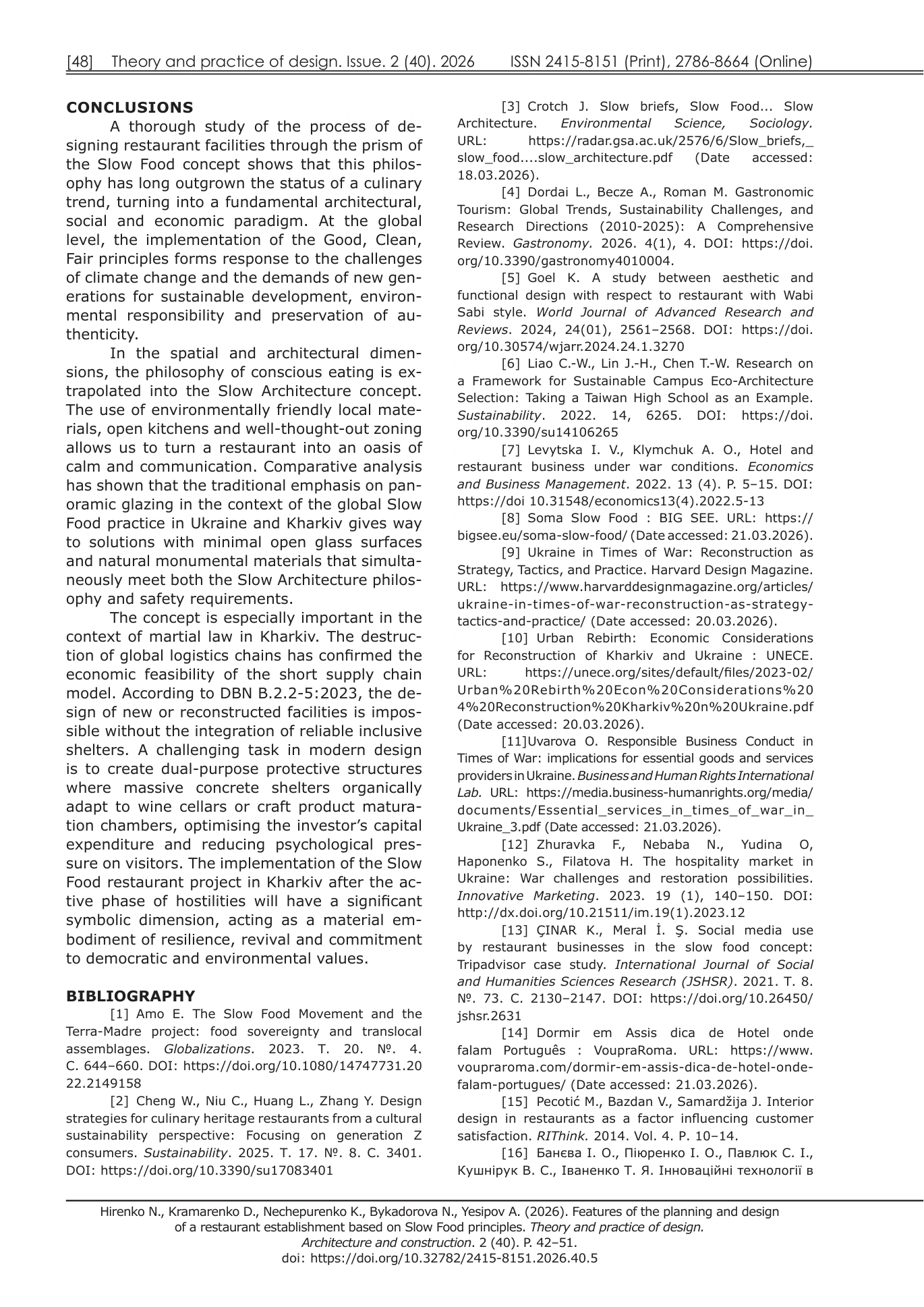
A comparative study of the interior de-
sign of Slow Food restaurants in the world and
in Ukraine reveals significant differences due to
security conditions. The foreign experience of
designing Slow Food restaurants is character-
ised by the widespread use of panoramic glazing
and open glazed terraces, which allows for
visual contact with the natural environment and
creates an atmosphere of openness and unity
with nature characteristic of this style. Leading
European and American establishments in this
segment often demonstrate maximum transpar-
ency of the building envelope, emphasising the
connection between the internal gastronomic
experience and the external landscape (Fig. 2 a)
[6]. However, in the Ukrainian context, in par-
ticular in the Kharkiv context of a full-scale armed
conflict, this approach is unacceptable from a
security point of view. Designers are forced to
abandon large-scale glazing in favour of monu-
mental enclosing structures made of brick, nat-
ural stone and wood, which not only provide an
authentic Slow Food atmosphere but also serve
as effective protection against shrapnel damage
(Fig. 2 b). The minimal number of windows with
explosion-proof double-glazed windows, deep
slopes and natural materials in the decoration
form a unique Ukrainian interpretation of Slow
Architecture, where the philosophy of conscious
consumption is organically synthesised with
wartime security imperatives.
Hirenko N., Kramarenko D., Nechepurenko K., Bykadorova N., Yesipov A. (2026). Features of the planning and design
of a restaurant establishment based on Slow Food principles. Theory and practice of design.
Аrchitecture and construction. 2 (40). P. 42–51.
doi: https://doi.org/10.32782/2415-8151.2026.40.5
Page 6 · text
ISSN 2415-8151 (Print), 2786-8664 (Online)
Теорія та практика дизайну. Вип. 2 (40). 2026
[47]
The design of the WRS in Kharkiv, a city of
one million people, is an architectural and social
challenge of the highest level of complexity [7].
The destruction of infrastructure and interrup-
tions in electricity and water supply have rad-
ically changed the paradigm of doing business.
However, Kharkiv has demonstrated incredible
resilience: the city is not only surviving, but is
actively developing post-war recovery strate-
gies. The work on the new Kharkiv master plan,
which involves the team of world-renowned
British architect Lord Norman Foster, envisages
the creation of a city of the future with a focus
on the high-tech economy, green infrastructure,
decentralisation and mixed-use spaces [9].
According to the experts of the United
Nations Economic Commission for Europe,
the city’s reconstruction should be based on
European standards and integrate the princi-
ples of environmental sustainability. Slow Food
restaurants, focused on local products and sus-
tainability, fit perfectly into the concept of Green
Kharkiv [9]. According to researchers of urban
space in the context of Ukraine’s reconstruction,
architecture is a significant protective tool and
manifestation of democratic values [15]. A high-
quality, aesthetically perfect environment can
serve as a physical and mental defence for so-
ciety. A restaurant in Kharkiv, built according to
the principles of Slow Architecture, can become
an urban space that generates a sense of sta-
bility, normalcy and hope for the future [15].
To ensure functioning under martial law,
designers are obliged to integrate autonomous
life support systems into the concept of the fa-
cility [3]. The most critical requirement for the
design of any public or commercial facility in
modern Ukraine, and especially in Kharkiv, is the
availability of a reliable civil protection system.
According to the current State Construction
Standards DBN V.2.2-5:2023 «Civil Protection
Facilities», all new or reconstructed civil protec-
tion facilities must be equipped with shelters or
dual-purpose structures [2]. This is not just a
legal formality, but a matter of saving the lives
of clients and staff [3].
Integrating a massive protective facility
into a Slow Food concept restaurant is a com-
plex architectural and engineering challenge.
The shelter should be designed using monolithic
reinforced concrete, which will provide resist-
ance to mechanical loads from blast waves, pro-
tection from radiation and heat resistance [2].
The concept of dual-purpose space should be
applied in the design to avoid turning the shelter
into a dead, economically inefficient zone. The
underground protected perimeter can be organ-
ically integrated into the technological and cus-
tomer structure of the restaurant. Ideal uses for
such a space in peacetime include: wine cellars
and tasting rooms (massive walls and lack of
natural light are ideal conditions for storing local
craft wines); aging rooms for craft cheeses or
fermented products; storage areas for organic
root vegetables to provide the restaurant with
local vegetables [24].
A critical aspect of designing a shelter is
compliance with the principles of barrier-free ac-
cess. Architects must provide gentle ramps of
standard width with anti-slip coating, widened
doorways without thresholds, special lifts with
backup power, and specially equipped sanitary
rooms [3]. This requirement perfectly correlates
with the «Fair» principle of the Slow Architecture
concept, declaring equal rights to safety and
comfort for every member of society [21]. The
interior design of the shelter should avoid de-
pressing colours; the use of warm, diffused
lighting, wood elements in furniture and wabi
sabi aesthetics (where concrete walls are per-
ceived as a stylistic solution, not a bunker) will
help reduce stress and panic among visitors [5].
а                                                                                                б
Fig. 2. Samples of enclosing structures [8; 14]
Гіренко Н. І., Крамаренко Д. П., Нечепуренко К. Б., Бикадорова Н. О., Єсіпов А. О. Особливості
проєктування та дизайну закладу ресторанного господарства з впровадженням принципів Slow Food.
Теорія та практика дизайну. Архітектура та будівництво. К.: КАІ, 2026. Вип. 2 (40). C. 42–51.
doi: https://doi.org/10.32782/2415-8151.2026.40.5
Page 7 · text
Theory and practice of design. Issue. 2 (40). 2026
ISSN 2415-8151 (Print), 2786-8664 (Online)
[48]
CONCLUSIONS
A thorough study of the process of de-
signing restaurant facilities through the prism of
the Slow Food concept shows that this philos-
ophy has long outgrown the status of a culinary
trend, turning into a fundamental architectural,
social and economic paradigm. At the global
level, the implementation of the Good, Clean,
Fair principles forms response to the challenges
of climate change and the demands of new gen-
erations for sustainable development, environ-
mental responsibility and preservation of au-
thenticity.
In the spatial and architectural dimen-
sions, the philosophy of conscious eating is ex-
trapolated into the Slow Architecture concept.
The use of environmentally friendly local mate-
rials, open kitchens and well-thought-out zoning
allows us to turn a restaurant into an oasis of
calm and communication. Comparative analysis
has shown that the traditional emphasis on pan-
oramic glazing in the context of the global Slow
Food practice in Ukraine and Kharkiv gives way
to solutions with minimal open glass surfaces
and natural monumental materials that simulta-
neously meet both the Slow Architecture philos-
ophy and safety requirements.
The concept is especially important in the
context of martial law in Kharkiv. The destruc-
tion of global logistics chains has confirmed the
economic feasibility of the short supply chain
model. According to DBN B.2.2-5:2023, the de-
sign of new or reconstructed facilities is impos-
sible without the integration of reliable inclusive
shelters. A challenging task in modern design
is to create dual-purpose protective structures
where massive concrete shelters organically
adapt to wine cellars or craft product matura-
tion chambers, optimising the investor’s capital
expenditure and reducing psychological pres-
sure on visitors. The implementation of the Slow
Food restaurant project in Kharkiv after the ac-
tive phase of hostilities will have a significant
symbolic dimension, acting as a material em-
bodiment of resilience, revival and commitment
to democratic and environmental values.
BIBLIOGRAPHY
[1]	 Amo E. The Slow Food Movement and the
Terra-Madre project: food sovereignty and translocal
assemblages. Globalizations. 2023. Т. 20. №. 4.
С. 644–660. DOI: https://doi.org/10.1080/14747731.20
22.2149158
[2]	 Cheng W., Niu C., Huang L., Zhang Y. Design
strategies for culinary heritage restaurants from a cultural
sustainability perspective: Focusing on generation Z
consumers. Sustainability. 2025. Т. 17. №. 8. С. 3401.
DOI: https://doi.org/10.3390/su17083401
[3]	 Crotch J. Slow briefs, Slow Food... Slow
Architecture.
Environmental
Science,
Sociology.
URL:
https://radar.gsa.ac.uk/2576/6/Slow_briefs,_
slow_food....slow_architecture.pdf
(Date
accessed:
18.03.2026).
[4]	 Dordai L., Becze A., Roman M. Gastronomic
Tourism: Global Trends, Sustainability Challenges, and
Research Directions (2010-2025): A Comprehensive
Review. Gastronomy. 2026. 4(1), 4. DOI: https://doi.
org/10.3390/gastronomy4010004.
[5]	 Goel K. A study between aesthetic and
functional design with respect to restaurant with Wabi
Sabi style. World Journal of Advanced Research and
Reviews. 2024, 24(01), 2561–2568. DOI: https://doi.
org/10.30574/wjarr.2024.24.1.3270
[6]	 Liao C.-W., Lin J.-H., Chen T.-W. Research on
a Framework for Sustainable Campus Eco-Architecture
Selection: Taking a Taiwan High School as an Example.
Sustainability.
2022.
14,
6265.
DOI:
https://doi.
org/10.3390/su14106265
[7]	 Levytska I. V., Klymchuk А. О., Hotel and
restaurant business under war conditions. Economics
and Business Management. 2022. 13 (4). P. 5–15. DOI:
https://doi 10.31548/economics13(4).2022.5-13
[8]	 Soma Slow Food : BIG SEE. URL: https://
bigsee.eu/soma-slow-food/ (Date accessed: 21.03.2026).
[9]	 Ukraine in Times of War: Reconstruction as
Strategy, Tactics, and Practice. Harvard Design Magazine.
URL: https://www.harvarddesignmagazine.org/articles/
ukraine-in-times-of-war-reconstruction-as-strategy-
tactics-and-practice/ (Date accessed: 20.03.2026).
[10]	 Urban Rebirth: Economic Considerations
for Reconstruction of Kharkiv and Ukraine : UNECE.
URL:
https://unece.org/sites/default/files/2023-02/
Urban%20Rebirth%20Econ%20Considerations%20
4%20Reconstruction%20Kharkiv%20n%20Ukraine.pdf
(Date accessed: 20.03.2026).
[11]	Uvarova О. Responsible Business Conduct in
Times of War: implications for essential goods and services
providers in Ukraine. Business and Human Rights International
Lab. URL: https://media.business-humanrights.org/media/
documents/Essential_services_in_times_of_war_in_
Ukraine_3.pdf (Date accessed: 21.03.2026).
[12]	 Zhuravka
F.,
Nebaba
N.,
Yudina
O,
Haponenko S., Filatova H. The hospitality market in
Ukraine: War challenges and restoration possibilities.
Innovative Marketing. 2023. 19 (1), 140–150. DOI:
http://dx.doi.org/10.21511/im.19(1).2023.12
[13]	 ÇINAR K., Meral İ. Ş. Social media use
by restaurant businesses in the slow food concept:
Tripadvisor case study. International Journal of Social
and Humanities Sciences Research (JSHSR). 2021. Т. 8.
№. 73. С. 2130–2147. DOI: https://doi.org/10.26450/
jshsr.2631
[14]	 Dormir em Assis dica de Hotel onde
falam Português : VoupraRoma. URL: https://www.
voupraroma.com/dormir-em-assis-dica-de-hotel-onde-
falam-portugues/ (Date accessed: 21.03.2026).
[15]	 Pecotić M., Bazdan V., Samardžija J. Interior
design in restaurants as a factor influencing customer
satisfaction. RIThink. 2014. Vol. 4. Р. 10–14.
[16]	 Банєва І. О., Піюренко І. О., Павлюк С. І.,
Кушнірук В. С., Іваненко Т. Я. Інноваційні технології в
Hirenko N., Kramarenko D., Nechepurenko K., Bykadorova N., Yesipov A. (2026). Features of the planning and design
of a restaurant establishment based on Slow Food principles. Theory and practice of design.
Аrchitecture and construction. 2 (40). P. 42–51.
doi: https://doi.org/10.32782/2415-8151.2026.40.5
Page 8 · text
ISSN 2415-8151 (Print), 2786-8664 (Online)
Теорія та практика дизайну. Вип. 2 (40). 2026
[49]
готельно-ресторанному господарстві : конспект лекцій
для здобувачів першого («бакалаврського») рівня
вищої освіти спеціальності 241 «Готельно-ресторанна
справа» денної та заочної форми навчання : Миколаїв :
МНАУ, 2023. 76 с.
[17]	 Гіренко Н. І., Крамаренко Д. П. Принципи
Slow Food у галузі ресторанного господарства України.
Якість та безпечність продукції у внутрішній і зовнішній
торгівлі
й
торговельне
підприємництво:
сучасні
вектори розвитку і перспективи : матеріали V Міжнар.
наук.-практ. конф., м. Полтава, 21 жовтня. 2025 р.
Полтава, 2025. С. 69–71.
[18]	 Дудка С-Р. О. Ергодизайнерські принципи
організації
інтер’єрних
просторів
ресторанних
закладів : автореф. дис. ... канд. мистецтвознавства :
17.00.07. Львів, 2019. 22 с.
[19]	 Оболенцева Л. В. Дослідження сучасного
стану, проблем та перспектив популяризації концепції
Slow
Food
у
ресторанах
України.
Міжнародний
науковий журнал «Інтернаука». Серія: Економічні
науки. Київ, 2025. № 3. С. 26–35. DOI: https://doi.
org/10.25313/2520-2294-2025-3-10767
[20]	 Оболенцева Л. В. Концепція «Slow Food»
як інструмент збереження гастрономічної спадщини та
сталого розвитку. Вiсник ХНУ iменi В. Н. Кapaзiнa. Сеpiя
«Мiжнapoднi вiднoсин. Екoнoмiкa. Кpaїнoзнaвствo.
Туpизм». 2025. № 22. С. 201–212. DOI: https://doi.
org/10.26565/2310-9513-2025-22-20
[21]	 Оболенцева
Л.
В.
Маркетингове
дослідження потреб споживачів ресторанних послуг:
обґрунтування впровадження концепції «Slow Food».
Економіка і регіон. 2025. №. 1 (96). С. 114–122. DOI:
https://doi.org/10.26906/EiR.2025.1(96).3754
[22]	 Оболенцева Л. В. Сутність, роль та значення
концепції Slow Food у сталому розвитку готельно-
ресторанного бізнесу. Модернізація економіки: сучасні
реалії, прогнозні сценарії та перспективи розвитку :
матеріали VІІ Міжнар. наук.-практ. конф. м. Херсон-
Хмельницький, 17-18 квітня 2025 р. Херсон, 2025.
541 с. С.376–378.
[23]	 Особливості дизайну інтер’єру кафе і
ресторанів : Design Prof URL: https://designprof.com.
ua/osoblyvosti-dyzajnu-interyeru-kafe-i-restoraniv/
(Дата звернення: 19.03.2026).
[24]	 Тренди
в
дизайні
готелів
та
ресторанів // Факультет готельно-ресторанного і
туристичного бізнесу. URL: https://fgritb.knukim.edu.
ua/home/news/trendy-v-dyzaini-hoteliv-ta-restoraniv.
html. (Дата звернення: 18.03.2026).
[25]	 Федосова
К.,
Кожевнікова
В.,
Шофул І. Проектування та дизайн ресторанних закладів
з
використанням
штучного
інтелекту.
Економіка
та
суспільство.
2025.
№.
78.
DOI:
https://doi.
org/10.32782/2524-0072/2025-78-108
[26]	 Хомич
Г.
П.,
Горобець
О.
М.,
Чоні І. В., Наконечна Ю. Г., Володько О. В. Нові підходи
до проєктування закладів ресторанного господарства.
Науковий вісник ПУЕТ. Серія «Технічні науки». Випуск
2. Видавничий дім «Гельветика», 2024. С. 25–31. DOI:
https://doi.org/10.37734/2518-7171-2024-2-4
REFERENCES
[1] Amo, E. (2023). The Slow Food Movement and
the Terra-Madre project: food sovereignty and translocal
assemblages. Globalizations, 20(4), 644–660. DOI:
https://doi.org/10.1080/14747731.2022.2149158
[2] Cheng, W., Niu, C., Huang, L., & Zhang, Y.
(2025). Design strategies for culinary heritage restaurants
from a cultural sustainability perspective: Focusing on
generation Z consumers. Sustainability, 17(8), 3401.
DOI: https://doi.org/10.3390/su17083401
[3] Crotch, J. (n.d.). Slow briefs, Slow Food. Slow
Architecture. Retrieved March 18, 2026, from https://radar.gsa.
ac.uk/2576/6/Slow_briefs,_slow_food....slow_architecture.pdf
[4] Dordai, L., Becze, A., & Roman, M. (2026).
Gastronomic Tourism: Global Trends, Sustainability
Challenges, and Research Directions (2010–2025)–A
Comprehensive Review. Gastronomy, 4(1), 4. DOI:
https://doi.org/10.3390/gastronomy4010004.
[5] Goel, K. (2024). A study between aesthetic
and functional design with respect to restaurant with
Wabi Sabi style. World Journal of Advanced Research
and Reviews, 24(01), 2561–2568. DOI: https://doi.
org/10.30574/wjarr.2024.24.1.3270
[6] Liao, C.-W., Lin, J.-H., & Chen, T.-W. (2022).
Research on a framework for sustainable campus eco-
architecture selection: Taking a Taiwan high school as
an example. Sustainability, 14, 6265. DOI: https://doi.
org/10.3390/su14106265
[7] Levytska, I. V., & Klymchuk, A. O. (2022).
Hotel and restaurant business under war conditions.
Economics and Business Management, 13(4), 5–15. DOI:
https://doi.org/10.31548/economics13(4).2022.5-13
[8] Soma Slow Food. (n.d.). BIG SEE. Retrieved
March 21, 2026, from https://bigsee.eu/soma-slow-food/
[9] Ukraine in times of war: Reconstruction as
strategy, tactics, and practice. (n.d.). Harvard Design
Magazine. Retrieved March 20, 2026, from https://www.
harvarddesignmagazine.org/articles/ukraine-in-times-of-
war-reconstruction-as-strategy-tactics-and-practice/
[10] Urban rebirth: Economic considerations for
reconstruction of Kharkiv and Ukraine. (2023). UNECE.
Retrieved March 20, 2026, from https://unece.org/sites/
default/files/2023-02/Urban%20Rebirth%20Econ%20
Considerations%204%20Reconstruction%20Kharkiv%20
n%20Ukraine.pdf
[11] Uvarova, O. (n.d.). Responsible business
conduct in times of war: Implications for essential goods
and services providers in Ukraine. Business and Human
Rights International Lab. Retrieved March 21, 2026,
from
https://media.business-humanrights.org/media/
documents/Essential_services_in_times_of_war_in_
Ukraine_3.pdf
[12] Zhuravka, F., Nebaba, N., Yudina, O.,
Haponenko, S., & Filatova, H. (2023). The hospitality
market in Ukraine: War challenges and restoration
possibilities. Innovative Marketing, 19 (1), 140–150.
DOI: http://dx.doi.org/10.21511/im.19(1).2023.12
[13] Cinar, K., & Meral, I. S. (2021). Social media
use by restaurant businesses in the slow food concept:
Tripadvisor case study. International Journal of Social
and Humanities Sciences Research (JSHSR), 8(73),
2130–2147. DOI: https://doi.org/10.26450/jshsr.2631
[14] Dormir em Assis dica de Hotel onde falam
Portugues. (n.d.). VoupraRoma. Retrieved March 21,
2026, from https://www.voupraroma.com/dormir-em-
assis-dica-de-hotel-onde-falam-portugues/
Гіренко Н. І., Крамаренко Д. П., Нечепуренко К. Б., Бикадорова Н. О., Єсіпов А. О. Особливості
проєктування та дизайну закладу ресторанного господарства з впровадженням принципів Slow Food.
Теорія та практика дизайну. Архітектура та будівництво. К.: КАІ, 2026. Вип. 2 (40). C. 42–51.
doi: https://doi.org/10.32782/2415-8151.2026.40.5
Page 9 · text
Theory and practice of design. Issue. 2 (40). 2026
ISSN 2415-8151 (Print), 2786-8664 (Online)
[50]
[15] Pecotic, M., Bazdan, V., & Samardzija, J.
(2014). Interior design in restaurants as a factor influencing
customer satisfaction. RIThink, 4, 10–14.
[16] Banieva, I. O., Piiurenko, I. O., Pavliuk, S. I.,
Kushniruk, V. S., & Ivanenko, T. Ya. (2023). Innovatsiini
tekhnolohii
v
hotelno-restorannomu
hospodarstvi
[Innovative
technologies
in
hotel
and
restaurant
industry]: konspekt lektsii dlia zdobuvachiv pershoho
(«bakalavrskoho») rivnia vyshchoi osvity spetsialnosti
241 «Hotelno-restoranna sprava» dennoi ta zaochnoi
formy navchannia. Mykolaiv: MNAU. 76 s. [in Ukrainian].
[17] Hirenko, N. I., & Kramarenko, D. P. (2025).
Pryntsypy Slow Food u haluzi restorannoho hospodarstva
Ukrainy [Slow Food principles in the restaurant industry of
Ukraine]. Yakist ta bezpechnist produktsii u vnutrishnii i
zovnishnii torhivli y torhovelne pidpryiemnytstvo: suchasni
vektory rozvytku i perspektyvy – Quality and safety of
products in domestic and foreign trade and commercial
entrepreneurship: current development vectors and
prospects: materialy V Mizhnar. nauk.-prakt. konf. Poltava,
21 zhovtnia 2025 r. Poltava. S. 69–71. [in Ukrainian].
[18] Dudka, S-R. O. (2019). Erhodyzainerski
pryntsypy orhanizatsii inter’iernykh prostoriv restorannykh
zakladiv [Ergodesign principles of organization of interior
spaces of restaurant establishments]: avtoref. dys.
... kand. mystetstvoznavstva: 17.00.07. Lviv. 22 s.
[in Ukrainian].
[19] Obolentseva, L. V. (2025). Doslidzhennia
suchasnoho
stanu,
problem
ta
perspektyv
populiaryzatsii kontseptsii Slow Food u restoranakh
Ukrainy [Research on the current state, problems and
prospects of popularizing the Slow Food concept in
Ukrainian restaurants]. Mizhnarodnyi naukovyi zhurnal
«Internauka». Seriia: Ekonomichni nauky – International
Scientific
Journal
«Internauka».
Series:
Economic
Sciences. Kyiv. No. 3. S. 26–35. DOI: https://doi.
org/10.25313/2520-2294-2025-3-10767 [in Ukrainian].
[20] Obolentseva, L. V. (2025). Kontseptsiia «Slow
Food» yak instrument zberezhennia hastronomichnoi
spadshchyny ta staloho rozvytku [The «Slow Food» concept
as an instrument for preserving gastronomic heritage
and sustainable development]. Visnyk KhNU imeni V. N.
Karazina. Seriia «Mizhnarodni vidnosyny. Ekonomika.
Krainoznavstvo. Turyzm» – Bulletin of V. N. Karazin KhNU.
Series «International Relations. Economics. Country
Studies. Tourism». No. 22. S. 201–212. DOI: https://doi.
org/10.26565/2310-9513-2025-22-20 [in Ukrainian].
[21] Obolentseva, L. V. (2025). Marketynhove
doslidzhennia potreb spozhyvachiv restorannykh posluh:
obgruntuvannia vprovadzhennia kontseptsii «Slow Food»
[Marketing research of the needs of restaurant service
consumers: substantiation of the implementation of the
«Slow Food» concept]. Ekonomika i rehion – Economy
and Region. No. 1 (96). S. 114–122. DOI: https://doi.
org/10.26906/EiR.2025.1(96).3754 [in Ukrainian].
[22] Obolentseva, L. V. (2025). Sutnist, rol ta
znachennia kontseptsii Slow Food u stalomu rozvytku
hotelno-restorannoho biznesu [The essence, role and
significance of the Slow Food concept in the sustainable
development of the hotel and restaurant business].
Modernizatsiia ekonomiky: suchasni realii, prohnozni
stsenarii ta perspektyvy rozvytku – Modernization of
the economy: current realities, forecast scenarios and
development prospects: materialy VII Mizhnar. nauk.-
prakt. konf. Kherson-Khmelnytskyi, 17–18 kvitnia 2025
r. Kherson. S. 376–378. [in Ukrainian].
[23]
Osoblyvosti
dyzainu
inter’ieru
kafe
i
restoraniv [Features of interior design of cafes and
restaurants]. (n.d.). Design Prof. Retrieved March 19,
2026,
from
https://designprof.com.ua/osoblyvosti-
dyzajnu-interyeru-kafe-i-restoraniv/ [in Ukrainian].
[24] Trendy v dyzaini hoteliv ta restoraniv
[Trends in hotel and restaurant design]. (n.d.). Fakultet
hotelno-restorannoho i turystychnoho biznesu – Faculty
of Hotel-Restaurant and Tourist Business. Retrieved
March 18, 2026, from https://fgritb.knukim.edu.ua/
home/news/trendy-v-dyzaini-hoteliv-ta-restoraniv.html
[in Ukrainian].
[25] Fedosova, K., Kozhevnikova, V., & Shoful, I.
(2025). Proektuvannia ta dyzain restorannykh zakladiv
z vykorystanniam shtuchnoho intelektu [Design of
restaurant establishments using artificial intelligence].
Ekonomika ta suspilstvo – Economy and Society. No. 78.
DOI: https://doi.org/10.32782/2524-0072/2025-78-108
[in Ukrainian].
[26] Khomych, H. P., Horobets, O. M., Choni, I. V.,
Nakonechna, Yu. H., & Volodko, O. V. (2024). Novi pidkhody
do proiektuvannia zakladiv restorannoho hospodarstva
[New approaches to designing restaurant establishments].
Naukovyi visnyk PUET. Seriia «Tekhnichni nauky» –
Scientific Bulletin of PUET. Series «Technical Sciences».
Vol. 2. Vydavnychyi dim «Helvetyka». S. 25–31.
DOI:
https://doi.org/10.37734/2518-7171-2024-2-4
[in Ukrainian].
АНОТАЦІЯ
Гіренко Н., Крамаренко Д., Нечепуренко К., Бикадорова Н., Єсіпов А.
Особливості проєктування та дизайну закладу ресторанного господарства
з впровадженням принципів Slow Food
Мета. Метою статті є комплексний аналіз теоретико-методологічних засад та
практичних аспектів проєктування й дизайну закладу ресторанного господарства,
що функціонує відповідно до принципів концепції Slow Food, а також розгляд
специфічних умов реалізації такого об’єкту у м. Харків в умовах воєнного стану
та перспектив повоєнного відновлення.
Методологія. У дослідженні застосовано комплекс загальнонаукових
і спеціальних методів: аналізу та синтезу – для систематизації нормативної бази
та наукових публікацій; порівняльного аналізу – для зіставлення підходів до
Hirenko N., Kramarenko D., Nechepurenko K., Bykadorova N., Yesipov A. (2026). Features of the planning and design
of a restaurant establishment based on Slow Food principles. Theory and practice of design.
Аrchitecture and construction. 2 (40). P. 42–51.
doi: https://doi.org/10.32782/2415-8151.2026.40.5
Page 10 · text
ISSN 2415-8151 (Print), 2786-8664 (Online)
Теорія та практика дизайну. Вип. 2 (40). 2026
[51]
дизайну ЗРГ у міжнародній та вітчизняній практиці; системного підходу – для
розгляду питань проєктування у взаємозв’язку архітектурного, функціонально-
технологічного та безпекового аспектів; узагальнення – для формулювання
висновків і практичних рекомендацій.
Результати. Визначено філософсько-концептуальні засади руху Slow Food
та їх проєкцію на архітектурну парадигму «Slow Architecture». Систематизовано
глобальні тенденції розвитку ЗРГ концепції Slow Food, включаючи принципи
сталого розвитку, цифровізацію та гастрономічний туризм. Розглянуто специфіку
функціонування ресторанної індустрії в Україні в умовах повномасштабної війни.
Сформульовано концепцію ЗРГ. Проаналізовано особливості дизайну інтер’єру
з урахуванням безпекової ситуації, а також вимоги ДБН В.2.2-5:2023 щодо
проєктування захисних споруд подвійного призначення.
Наукова новизна. Запропоновано концептуальну модель проєктування
ЗРГ формату Slow Food в умовах збройного конфлікту, що поєднує принципи
Slow Architecture, безпекові імперативи воєнного часу та регіональну культурну
ідентичність Харківського регіону. Вперше систематизовано підходи до дизайну
укриттів подвійного призначення у ЗРГ концепції Slow Food.
Практична значущість. Результати дослідження можуть бути використані
проєктними організаціями, інвесторами ресторанного бізнесу та органами
місцевого самоврядування при розробці концепцій і проєктів ЗРГ у містах
України, що знаходяться поблизу зони бойових дій. Запропоновані рішення щодо
просторів подвійного призначення дозволяють оптимізувати капітальні витрати
та підвищити інвестиційну привабливість закладу.
Ключові слова: Slow Food, заклад ресторанного господарства, Slow
Architecture, проєктування, дизайн інтер’єру, сталий розвиток, вабі-сабі, захисні
споруди, ДБН В.2.2-5:2023, Харків, воєнний стан, гастрономічний туризм,
локальні продукти, відкрита кухня, безпекові рішення.
АВТОРСЬКА ДОВІДКА:
Гіренко Наталія, кандидат технічних наук, доцент, доцент кафедри професійної
освіти, ресторанного і туристичного бізнесу, Державний заклад «Луганський національний
університет імені Тараса Шевченка», Лубни, Україна, e-mail: n.i.hirenko@gmail.com,
orcid: 0000-0001-6854-8257.
Крамаренко Дмитро, кандидат технічних наук, доцент, доцент кафедри готельного,
ресторанного бізнесу і крафтових технологій, Харківський національний економічний
університет імені Семена Кузнеця, Харків, Україна, e-mail: kramarenkodp@gmail.com,
orcid: 0000-0003-1353-686X.
Нечепуренко Кристина, кандидат технічних наук, доцент кафедри готельного,
ресторанного бізнесу і крафтових технологій, Харківський національний економічний
університет імені Семена Кузнеця, Харків, Україна, e-mail: krystyna.nechepurenko@hneu.net,
orcid: 0000-0002-1815-2542.
Бикадорова Наталія, старший викладач кафедри професійної освіти, ресторанного і
туристичного бізнесу, Державний заклад «Луганський національний університет імені Тараса
Шевченка», Лубни, Україна, e-mail: itottstar@gmail.com, orcid: 0000-0002-7561-1792.
Єсіпов Андрій, старший викладач кафедри архітектури, Харківська державна
академія
дизайну
та
мистецтв,
Харків,
Україна,
e-mail:
esipov1995@gmail.com,
orcid: 0000-0001-8657-0714
Дата першого надходження статті до видання: 26.03.2026
Дата прийняття статті до друку після рецензування: 17.04.2026
Дата публікації (оприлюднення) статті: 30.05.2026
Стаття поширюється на умовах ліцензії
відкритого доступу CC BY 4.0
Гіренко Н. І., Крамаренко Д. П., Нечепуренко К. Б., Бикадорова Н. О., Єсіпов А. О. Особливості
проєктування та дизайну закладу ресторанного господарства з впровадженням принципів Slow Food.
Теорія та практика дизайну. Архітектура та будівництво. К.: КАІ, 2026. Вип. 2 (40). C. 42–51.
doi: https://doi.org/10.32782/2415-8151.2026.40.5